[ad_1]
During my twelve-day stay in Japan earlier this month, A and I visited Tsukiji fish market located in central Tokyo. With more than 60,000 working staff, Tsukiji fish market is the largest fish and seafood market in the world, and one of the biggest food markets of any kinds such as vegetables, fruits, meat, and flowers. Considering the Japanese diet that is mostly based on marine products, it’s no wonder why the largest fish market in the world exists in Japan. Like any other markets, Tsukiji is closed on Sunday and public holidays. Shops and restaurants in Tsukiji typically open in early morning (around 5AM) and close between 12PM and 2PM. The view of wide varieties of fresh fish and other seafood, as well as the hectic environment of scooters, turrets, trucks, and forklifts rushing around, create Tsukiji market one of top tourist attractions in Tokyo. As we arrived there for the first time, the market seems chaotic at first glance, but everyone knows their way around and does everything faster, with surprisingly very little margin for errors.
Tsukiji market is divided into several major sections that include wholesale areas, shops and restaurants, delivery centers, and offices. There are six separate wholesale areas for different food categories: tuna, live fish, fresh fish, salted and dried fish, other marine products, and farm products. The size of the market was so big that we got lost once we got there. Assuming that nowadays young people generally learn English in school, we asked several young people for directions; but sadly, they couldn’t communicate well in English. We almost gave up, and then suddenly an old Japanese gentleman approached us and kindly questioned us in not-so-good English (but understandable) about what we intended to do in the market. We were delighted that, with the nice old man’s help, we finally knew where to go. Lucky us! Next time, we should consider to asked older people too for directions.
We heard that restaurants in Tsukiji boast the freshest seafood in Tokyo and offer not-so-expensive price. Therefore, our first stop was Uogashi-Yokocho, which was the shops and restaurants area in Tsukiji, to find a sushi restaurant for breakfast. Although it was 8:30 in the morning, restaurants in Tsukiji were still jam-packed. I cannot imagine how crowded it would be during lunch time. Two most famous sushi restaurants in Tsukiji are Daiwa Sushi and Sushi Dai. Surprised by the incredible wait in front of Sushi Dai, we diverted to Daiwa Sushi that had no long queue at that time. The restaurant had tiny space containing a small sushi bar that could only accommodate ten customers. I don’t really like eating raw food. However, thinking that I was at the place where you can find the freshest raw sushi, I dare to order various kind of toro and some other raw fish sushi for my breakfast. Whereas A (who is a sushi lover) ordered the omakase set menu (costing 3,500 yen) that comes with tuna, eel, squid, shrimp, sea urchin, six tuna rolls, and tamago. After breakfast, A acknowledged that it was truly the best sushi ever in his life. He said that he would have a difficult time enjoying sushi outside of Japan after tasting the amazingly fresh and delicious sushi around Tsukiji market. There is simply no comparison.
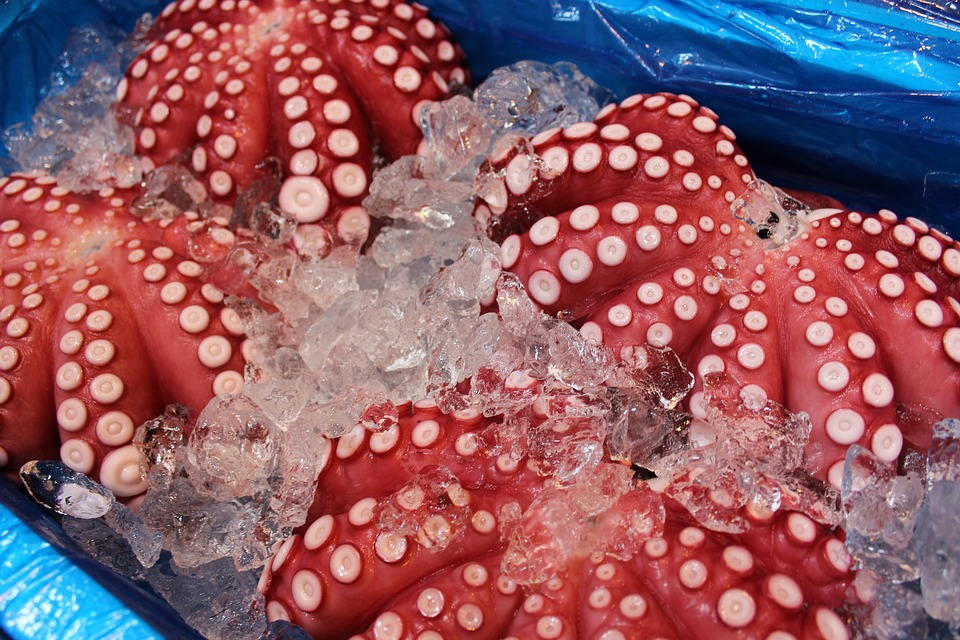
After breakfast, we wandered around the marine products section, where inside the giant warehouse we found aisle after aisle of seafood vendors packed closely together, leaving only narrow lanes for pedestrians and transport trolleys. We saw palm-sized clams, shellfish, big crab claws, colorful octopus, squids, live prawns, live Unagi eels, and all other exotic sorts of living marine creatures that I had never seen previously. We also saw huge frozen tuna fish being cut and axed into small parts for sale at the market. Inside the fish market, we were amazed that we couldn’t sense any offensive smells, which we thought very unusual for such a huge fish market like Tsukiji market. Later I discovered that this was due to the very high standards of cleanliness observed by the market, and throughout Japan for public sanitation, to maintain the safety of the market food products.
It was unfortunate that we had no chance to witness the spectacular tuna auctions in the early morning hours. With Japanese eating one quarter of the world’s total supply of tuna fish each year, giant tuna sold in Tsukiji market come from all around the world as far away as New Zealand and Tahiti. The tuna auction begins at 5:30AM. The tuna auctioneer initially asks for the bid price in a loud voice, and then middlemen and authorized buyers bid against each other. They sell all tuna out very quickly. At 7AM, all middlemen receive and transport the tuna that they have bought to their own stalls so that other buyers can purchase their tuna easily. The record of the most expensive tuna in Tsukiji market was an enormous Bluefin tune auctioned in January 2001 with a shocking price of US$184,000. Wow! Additionally, problems related to the increasing number of visiting tourists have arisen since the booming popularity of Tsukiji market. Sadly because of this reason, starting from April 2008, tourists are allowed to watch the auctions only from the designated visitor area, and the use of flash photography is no longer permitted.
Since A were craving about sushi all the time we were at Japan, so a week later, we returned to Tsukiji market to have a lunch. A decided to try chirashi, which basically is sushi toppings served scattered over a bowl of sushi rice. There are two restaurants that stand next to each other and have only chirashi in their menu. I didn’t know the restaurant names because they’re written in Japanese characters. After looking at their menus, we then picked the one located at the corner of the alley. It’s true that, during lunch time, restaurants in Tsukiji market are jammed with more customers than during breakfast time. But it wasn’t too bad; we waited for approximately 30 minutes before entering the restaurant. A ordered a bowl of chirashi that has a generous portion of two kinds of tuna meats: akami (the leaner meat from the sides of the fish) and chutoro (the fatty meat from the belly area of the fish). And I ordered ebi furai. The crispy deep fried very large prawn served with mayonaise was the best ebi furai I’ve ever had. The prawns were very fresh and come from a good quality of shrimp. The bad thing is they didn’t provide rice to eat with. But I had an idea to take some of A’s sushi rice. Yippie…! Again, A could not agree more that no restaurants outside the market could beat the flavor of the exceptionally fresh tuna served in Tsukiji market’s restaurants. O yeah… I almost forget to tell you that we supposed not allowed to take any picture inside the restaurant, but A was success to sneak in to get some few shots for the dishes we had.
Last thing what I would like to say, a vacation in Tokyo is not complete without a unique and memorable experience of visiting the Tsukiji fish market. Definitely a place to see in Japan!
[ad_2]
Source by Yunike Setiyono